





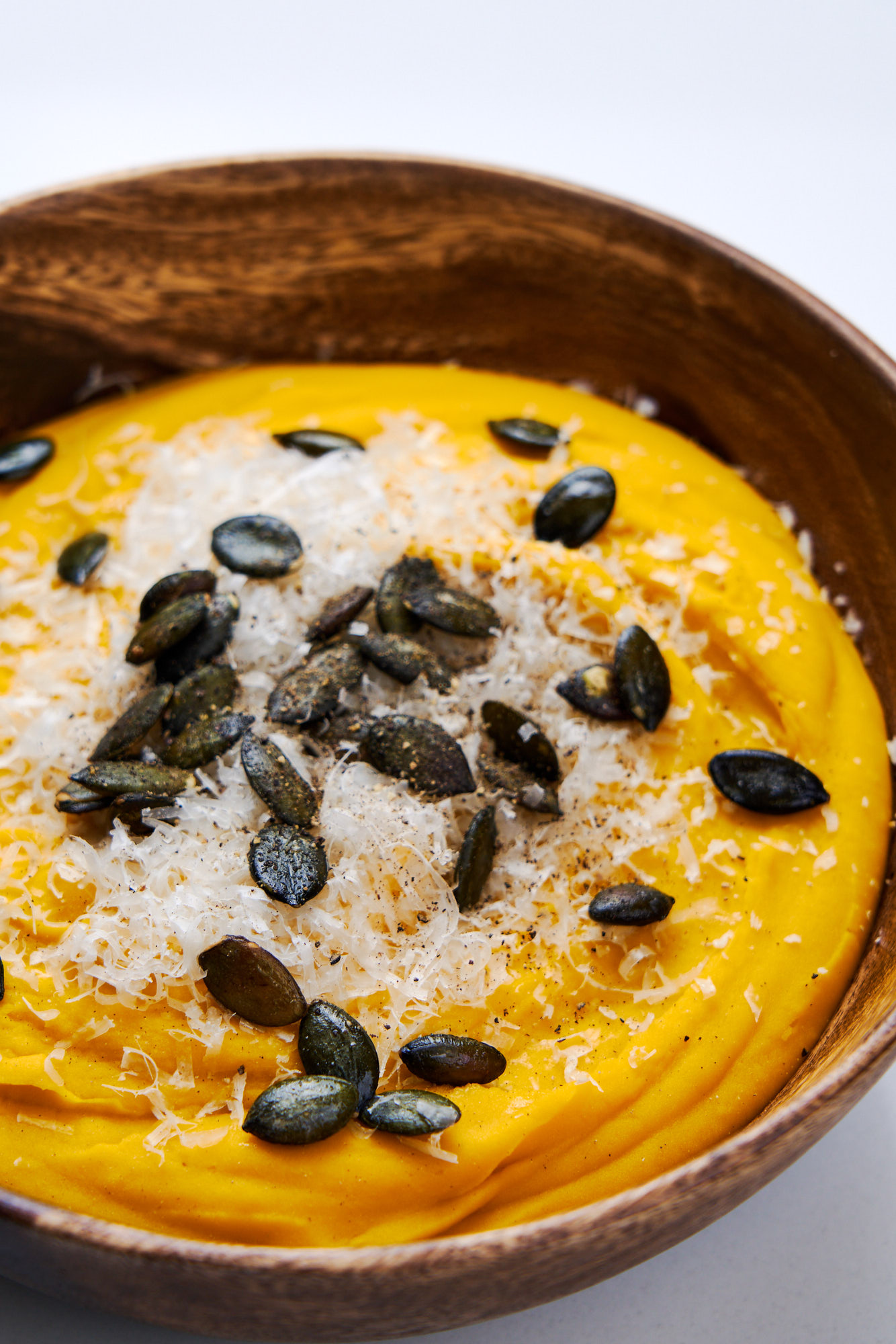
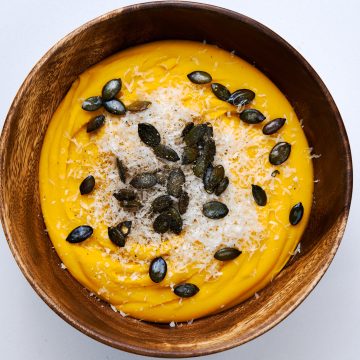
If you celebrate American Thanksgiving, this mashed kabocha is a delicious, colorful alternative to mashed potatoes that appears regularly on my autumn table. But, even if you're in another part of the northern hemisphere, this vibrant side is a great way to make use of Kabocha.
Aside from being festive and sweet, kabocha has a few distinct advantages over potatoes. If you've ever over-mashed your potatoes and had them turn into glue, you'll be happy to know that it's almost impossible for this to happen with kabocha due to its lower starch content. This opens up the possibility of using tools like blenders and food processors to mash the pumpkin and achieve a smoother texture.
Kabocha also cooks faster than potatoes, and by cooking it in milk and butter, there's no need to drain it or heat the milk and butter separately. This makes this dish super easy to prepare, especially when you're juggling the preparation of a half dozen dishes.
Kabocha takes a while to mature (even after it looks ready to pick), and underripe kabocha tends to have a high moisture content with low starch and sugar content which will not work well for this recipe. When chosing kabocha look for one that is relatively heavy for it's size with very hard skin. If you can find them cut in half look for one with flesh that's more orange than yellow. Check this page out for what a ripe kabocha should look like.
Although kabocha skin is edible, you'll want to do a good job in removing all of the green parts of the skin, or your mash is going to turn an unappealing shade of greenish-brown.
Welcome to my Secret Stash!
I’m Marc Matsumoto, creator of No Recipes and author of the award winning cookbook Ultimate Bento. You’ve stumbled upon my secret stash with 378 original recipes with a new one coming every week! Unlike my other site, these recipes are member-supported, so you won’t find any banner ads here. If you enjoy this recipe below, please consider becoming a member to access the rest of my private cookbook and get updates with my latest recipes.
- ✓ No ads
- ✓ Access the full stash of 378 recipes
- ✓ 1 new recipe per week
- ✓ Support Norecipes.com
Units
Ingredients
- 480 grams kabocha
- 1 cup milk
- 2 tablespoons cultured unsalted butter
- ½ teaspoon salt
- Hard grating cheese like Pecorino Romano for garnish
- Pumpkin seeds for garnish
Instructions
-
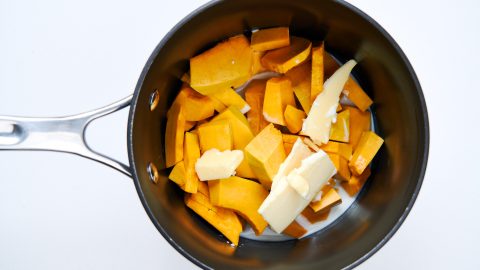
Peel the kabocha, slice it into relatively thin pieces (the thinner you slice it, the faster it will cook), and put them in a pot. Add the milk, butter, and salt and cover the pot with a lid.

- Bring the pot to a simmer and cook over low heat stirring periodically until the kabocha is cooked through and tender.
-
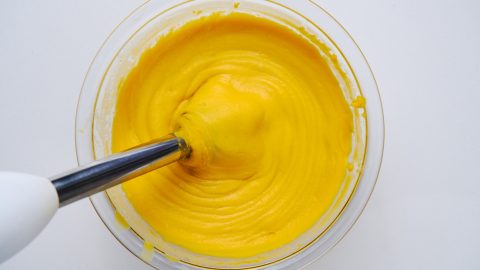
When the pumpkin is tender, mash everything together, adding additional milk if needed to get a creamy texture. I used a stick blender, but a food processor, blender, or potato masher will work.
-
Serve garnished with grated cheese and roasted pumpkin seeds.

Kristopher Zemlyak says
Some steps are missing here between 1 and 2. I took a guess and brought the covered pot to a boil on the stovetop and then let it simmer until the squash was soft. The milk scalded and I ended up with something more like soup than mash. Maybe it was supposed to go in the oven?
Marc Matsumoto says
Hi Kristopher, I'm so sorry to hear this didn't work out. It's my fault for not writing in more clearly the cooking instructions. You want to cook the pumpkin at a low simmer and it needs to be stirred periodically to keep the milk from scalding. I've added in a step 2 explaining. As for why your mash turned out loose assuming you measured out all the of the ingredients the only thing I can think of is that the kabocha you used may have been one with a higher moisture content and lower starch content. After being cooked the kabocha should have a starchy texture similar to potatoes.
There have been a few times I've run across kabacha that have had a high moisture content and I usually know it's going to be a problem when I cut it. Kabocha tends to be very hard and difficult to cut (sometimes it feels like you're trying to cut a block of wood). The higher moisture ones tends to be relatively easier to cut. I'm not sure if this has to do with the cultivar or the curing time. If you still have leftovers my recommendation would be to turn what you have left into soup by adding chicken stock and salt and blending it until smooth.
Marc Matsumoto says
Hi Kristopher, I just spoke with someone with more knowledge about kabocha than me, and they think it might be an issue with the maturity of the kabocha you used. Underdeveloped kabocha doesn't look all that different from fully mature kabocha on the outside, but it has a much lower starch/sugar content and a higher moisture content. The 4th photo on this page https://postharvest.ucdavis.edu/Commodity_Resources/Fact_Sheets/Datastores/Vegetables_English/ clearly illustrates the difference.
Kristopher Zemlyak says
Thanks for the reply, Marc! I actually used butternut squash for the reasons you outlined - although kabocha is easily available here year-round, it's rarely of good quality. Im guessing butternut also has higher moisture, so I think the tip about adjusting the liquid based on the squash will help. And, taking your other suggestion, this batch did end up as a pretty tasty soup. 🙂