




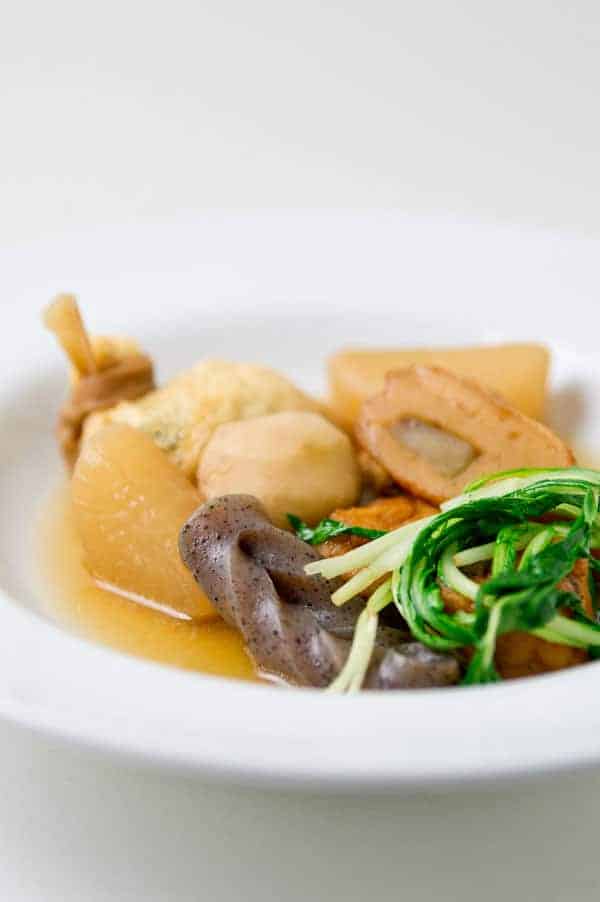
During the frigid winter months, it’s only natural to crave comfort. For some of us, comfort comes in the form of flannel pajamas and fuzzy slippers, for others it shows up in a hot steaming bowl. Oden is the quintessential comfort food in Japan to take the chill off of winter.
As soon as the leaves start turning color in fall, street carts, ramen shops and izakayas (pubs) all over Japan start serving the simple warming stew. You can even get it in cans out of vending machines. In a way, oden is a bit like what corned beef and cabbage is to Irish Americans.
What’s your favorite comfort food?
While there are many regional variations, the oden I grew up eating uses a light dashi broth with fishcake, egg, konyaku, tofu products and vegetables in it. The ingredients are simmered together and are served with karashi (hot mustard). Like all stews, this one is best made in advance and given at least a day in the fridge for all the flavours to saturate into all the items that are in the broth.
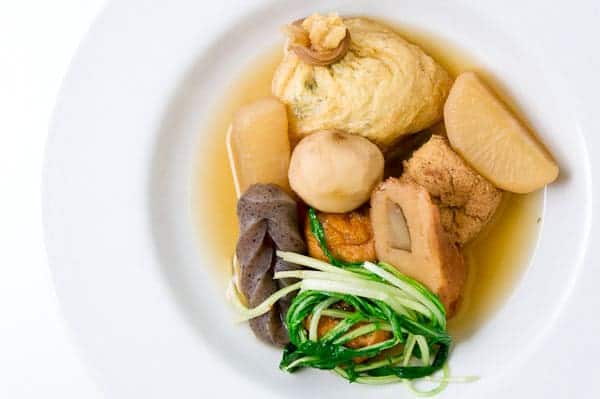
I like to make a big pot of this at least once a year. The sweet smoky aroma of dashi is like a plush feather bed for my nose, and the wide assortment of tender fishcakes, vegetables, and tofucakes is light, yet deeply satisfying for a body that’s been burning calories trying to keep warm.
Best of all, the leftovers are great for making Tteokbokki, a spicy Korean stew that starts with oden.
Group 1
- Daikon– These are the long white Japanese radishes, they are peeled, then sliced into thick rounds which come out soft and flavourful when stewed in oden.
- Kabocha– These Japanese pumpkins have a mottled green skin and dark orange interior and have a texture somewhere between butternut squash and sweet potato. Cut them into big wedges. If your kabocha is relatively thin, you may want to wait until the daikon is halfway done before adding it.
- Sato-Imo– These are Japanese taro roots and are much smaller than the type used in other asian cuisines (about the size of a baby potato and no bigger than a small potato). Peel them and leave them whole if they are small or cut them in half if they are a little bigger.
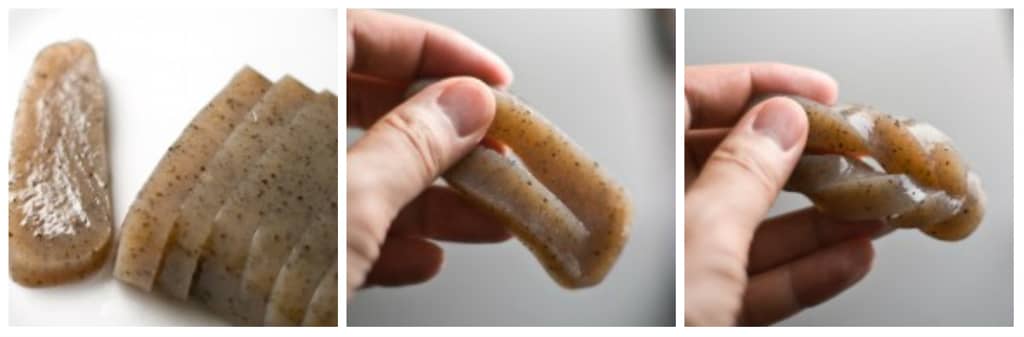
- Konyaku– This is one of my favorite things in oden, but may not be for everyone. It’s a hard jelly that’s made from the root of a plant. The texture is a bit hard to describe, but it’s a gelatinous substance that is vaguely crunchy –kind of like some mushrooms and jellyfish are. There’s a trick to give them a braided look which also helps them absorb more flavor. Cut it into ¼″ thick slices then cut a slit vertically down the center leaving ¼″ at the top and ¼″ at the bottom intact. Then you take one end and stuff it through the hole you’ve cut int the center and pull it through to the other side. I know this sounds complicated, but take a look at the pics below.
- Tofu– If you use plain tofu, you’ll want to make sure you’re using firm tofu, otherwise it will come apart while cooking.
- Ganmoudoki– I’m not entirely sure how these are made, but they’re little round cakes made of tofu and shredded vegetables that are deep fried. It has a slightly spongy texture, so it absorbs the broth nicely.
- Atsuage– This literally means “thick deep fried” and is thick cut firm tofu that’s been deep fried giving it a browned “shell” on the outside that helps keep the tofu from falling apart while simmering.
- Chikuwa– These cylindrical tubes are a form of fish cake.
- Satsuma-age– “age” is pronounced “ah-geh” and is another type of fish cake with veggies such as carrots, green beans and burdock in it.
- Other fishcakes– You can use pretty much any kind of fishcake you like or can find including kamaboko, imitation crab, fish balls (chinese), etc.
Group 2
- Soft boiled egg– Typically you put hard boiled eggs in and cook them along with everything else so it soaks up the flavors, but I hate overcooked egg yolk. I’ve found a good compromise is to soft boil the eggs then drop them in the soup after you’ve cooked all the other stuff and then leave it in the fridge overnight. After a day of soaking in the broth, the eggs will be perfectly flavored and cooked.
- Hanpen– This is a unique fishcake in that it’s very light and spongy, quite literally like a cake. It’s very delicate though and if you cook it too long it will turn into mush. I like to put it in after the first cooking and before rewarming the oden.
- Kinchaku– It’s abura-age (thinly sliced deep fried tofu) stuffed with a small piece of mochi (rice cake) and tied into a little purse with kampyo (dried strips of gourd). These are great, because the abura-age absorbs the broth while the mochi inside gets all melty and soft. Thanks for the name Pakupaku.
Make sure you are using a good quality dashi (preferably made from scratch), this is what flavors everything. Add the mirin, light soy sauce, and salt and bring to a simmer. If you can’t find light soy sauce (a.k.a. Usukuchi Soy Sauce), you can substitute 1 Tbs of regular soy sauce and add extra salt. The broth should be slightly saltier that a regular soup, but not so salty you can’t drink it.
This recipe first appeared on norecipes.com but due to its age I've moved it here to my personal recipe archive. Check out the full No Recipes Archives for more older recipes, or check out some of my favorite recipes.
Units
Ingredients
For broth
- 4 cups dashi stock (made with bonito and kombu)
- 3 tablespoons mirin (sweet Japanese cooking wine)
- 2 tablespoons soy sauce light colored (this is not the same as u201clow sodium u201d)
- 1 tablespoons kosher salt (halve if using table salt)
- Choose 3-4 items from Group 1 above
- Choose 1-2 items from Group 2 above
Instructions
- Add the items from Group 1 into the broth, cover, and allow it to gently simmer over low heat until the ingredients like the daikon and kabocha are tender (45 minutes to 1 hour). If it boils, the vegetables will start to fall apart. Take the oden off the heat and allow it to cool down to room temperature.
- Add the eggs and push them to the bottom of the pot then top with any other items in Group 2 you are using. Stick the whole pot of oden in the fridge for one day to allow the flavours to mature. When you're ready to eat the oden, gently warm up the pot and serve with some karashi and rice. It's also great served as an appetizer with beer or sake.



Comments
No Comments